ChatGPT vs Claude vs Gemini vs Grok: How the Major AI Platforms Differ
The major assistants are converging on capability and diverging on judgement, interface and who they're really built for. A practical comparison rather than a leaderboard.
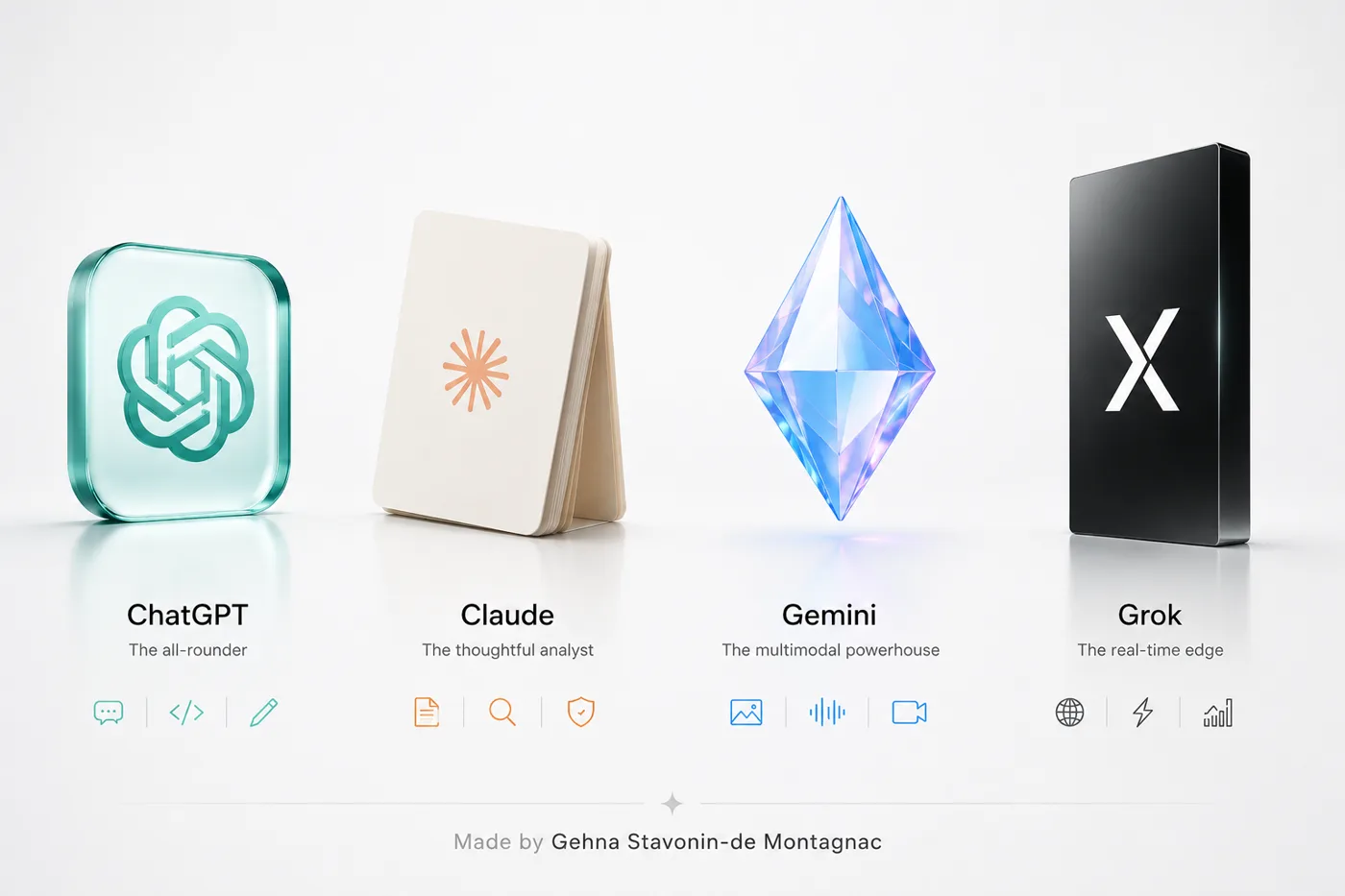
Ask which AI model is "best" and you'll get a different answer depending on the week, the benchmark and who's selling what. That's not a dodge — it's the actual state of the market. The four platforms most people encounter — OpenAI's ChatGPT, Anthropic's Claude, Google's Gemini and xAI's Grok — have converged hard on raw capability. The more useful question isn't which one is smartest. It's which one is built for what you're actually trying to do.
Fact: all four now ship multimodal models capable of reasoning over text, images and, increasingly, documents and code, with context windows large enough to hold entire codebases or long reports. All four offer a free tier and a paid tier with higher limits and more capable models. Benchmark scores on any given month are close enough that they're a weak signal on their own — model releases leapfrog each other every few months.
Where they actually diverge
The differences that matter day-to-day aren't in raw intelligence, they're in disposition and integration.
ChatGPT has the broadest consumer surface area — voice mode, a large plugin and GPT ecosystem, and the deepest integration into OpenAI's own tools. It tends to be the default choice because it was first and because it's genuinely strong at broad, general-purpose tasks.
Claude has built a reputation for longer, more careful reasoning and a writing style that reads less like "AI voice" — less hedging filler, fewer bullet-pointed non-answers. It's become a preferred tool for people doing serious writing, analysis or coding work, particularly through Claude Code and its API-first approach for developers building products rather than chatting.
Gemini's advantage is Google's distribution: it's wired directly into Search, Workspace, Android and, increasingly, the browser. If your working life already lives in Gmail, Docs and Sheets, Gemini removes a lot of copy-paste friction that the others can't.
Grok's differentiator is its integration with X (Twitter) and real-time access to that platform's data, plus a more informal, occasionally irreverent tone. It's a reasonable choice if live social discourse is part of your workflow, less so if you want a neutral, buttoned-up assistant.
Analysis, not verdict
None of this makes one platform objectively correct. A developer building an agentic coding workflow has different needs from a marketer drafting social copy or a trader wanting fast access to breaking sentiment. The honest framing is: these are becoming less like search engines and more like operating environments, each with its own defaults, its own personality, and its own ecosystem lock-in. Which one you should use depends on which ecosystem you're already in and which failure mode annoys you least — overconfidence, over-hedging, or over-formality.
A prediction, held loosely: the meaningful competition over the next few years won't be who has the smartest model in isolation — those gaps will keep narrowing — it'll be who best embeds a model into the tools people already use without making the AI the point of friction. Distribution, not raw benchmark scores, is likely to decide who wins the average user, even as frontier labs keep competing hard on capability for developers and power users.
If you're choosing for the first time, the practical move is simple: use the free tier of each for a week doing your actual work, not toy prompts, and notice which one you stop needing to double-check.
Written by
Gehna Stavonin-de Montagnac
Writing on artificial intelligence, software, automation, business and finance.
Related articles
Creating Images with Nano Banana Pro: Notes from Actually Using It
Hands-on notes on generating images with Nano Banana and Nano Banana Pro, building a phone-friendly version of an AI studio, and the idea of an image's 'JSON DNA.'
Are Open-Weight Models the Future of AI?
Open-weight releases from Meta, Mistral, DeepSeek and others have closed the gap with closed frontier labs faster than expected. What that does — and doesn't — mean.