The Future of Accounting in an AI-Assisted World
AI won't replace accountants. It will remove the parts of the job that were never really accounting in the first place — and raise the bar on the parts that are.
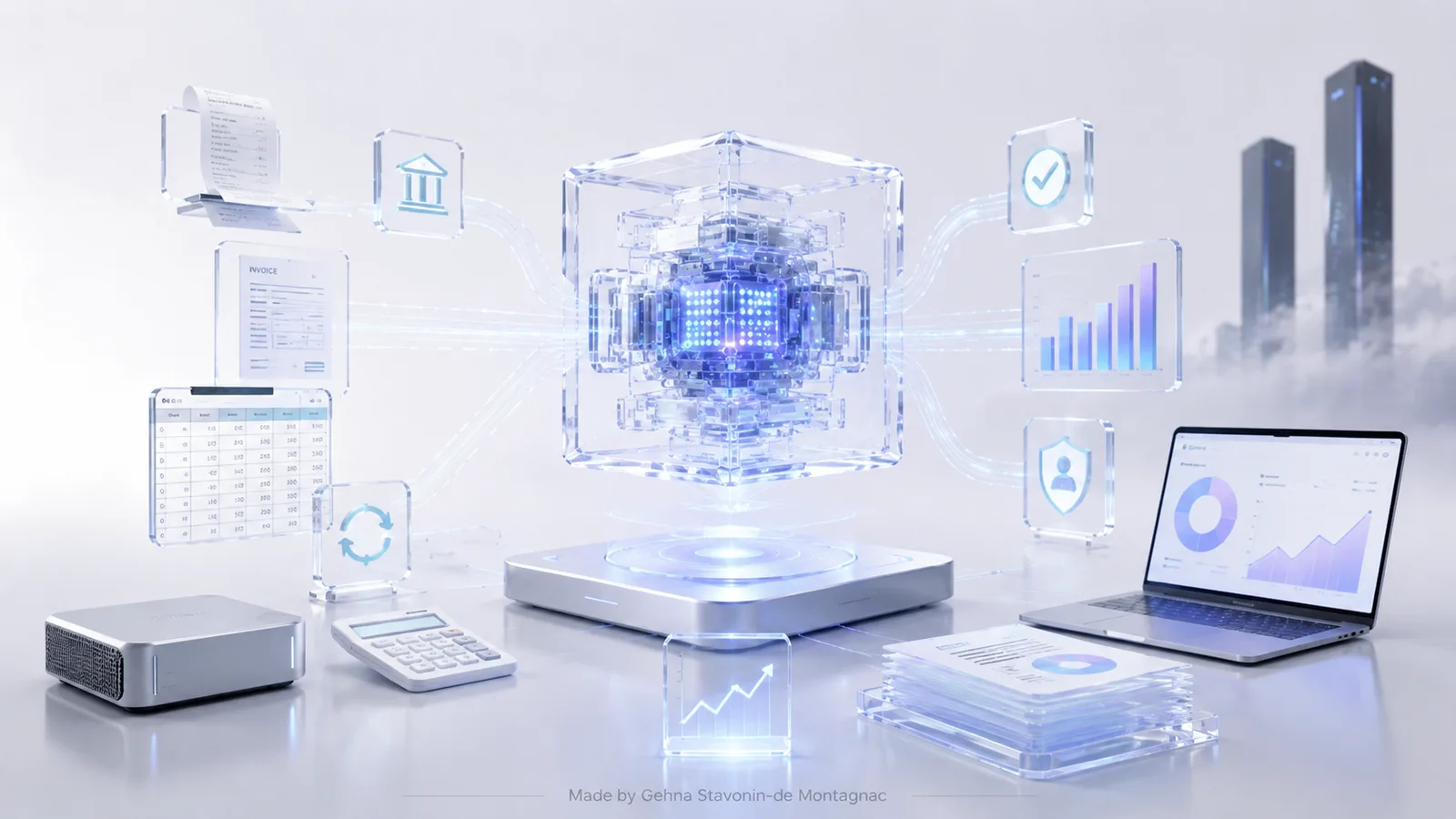
Every few years, a new technology arrives that gets described as "the end of accounting." Spreadsheets were supposed to eliminate bookkeepers. Cloud software was supposed to eliminate practices entirely. Neither happened, and it's worth understanding why before assuming AI is different.
Fact: a large share of traditional accounting work — data entry, bank reconciliation, basic categorisation, chasing missing receipts, first-draft management accounts — is exactly the kind of structured, repetitive, rules-based task that current AI systems are genuinely good at. Software already automates much of this through bank feeds and rules engines; AI extends that automation to messier, less structured inputs — a photographed receipt, an ambiguous invoice, an email describing a transaction in plain language.
What actually changes
This is not new to accounting — it's the continuation of a trend that's been running since double-entry software replaced paper ledgers. What's different this time is the breadth of what can be automated. Judgement calls that used to require a human — "is this a capital or revenue expense," "does this transaction look like it's been miscategorised" — are increasingly things AI can flag or draft an answer to, even if a human should still sign off.
Analysis: the work that survives and grows in value is the work that was never really "accounting" in a mechanical sense — it's advisory. Interpreting what the numbers mean for a specific business, spotting a client's cash flow problem before it becomes a crisis, explaining tax implications of a decision in plain language, negotiating with HMRC, being a calm, trusted voice a business owner can call when something goes wrong. None of that is threatened by AI; if anything, it becomes more valuable as the mechanical work becomes cheaper and faster, because it frees up an accountant's time to actually do it.
There's a real risk on the other side too, and it's worth naming plainly: firms that compete purely on doing the mechanical work cheaply — bookkeeping-as-a-commodity — are exposed. If a task can be fully described in rules, it can eventually be automated away or commoditised, and no amount of "we've always done it this way" protects that segment of the market.
Opinion: the accountants who do best over the next decade won't be the ones who resist AI tools, and they won't be the ones who use AI as a excuse to hollow out client relationships into a fully automated product. They'll be the ones who use automation to compress the mechanical 80% of the job into a fraction of the time, and reinvest that time into the 20% that actually required a human — judgement, context, and trust.
Prediction, held loosely: within the next few years, "AI-assisted bookkeeping" stops being a differentiator and becomes table stakes, the same way cloud accounting software did. The differentiator moves entirely to advisory quality, responsiveness, and specialisation in a niche the accountant genuinely understands — which is a much better basis for a small practice to compete on than being the cheapest data-entry option in the market.
Written by
Gehna Stavonin-de Montagnac
Writing on artificial intelligence, software, automation, business and finance.
Related articles
What AI Adoption Actually Does to a Firm's Turnaround Time
AI genuinely speeds up the mechanical stages of accounting work. What that does — and doesn't — do to a firm's overall turnaround time.
Why Business Software Is Becoming More Personalised
Generic, one-size-fits-all software is giving way to tools shaped around how a specific business actually works. Full article coming soon.